Inline Diagnostic Unit 2 (IDU2) and Noise Vibration and Harshness (NVH) Sensor (G4667907)
What is the Inline Diagnostic Unit 2 (IDU2) and Noise, Vibration and Harshness (NVH) Sensor?
The IDU2 and NVH Sensor are mandatory tools designed to be used with JLR approved diagnostic equipment to assist in the diagnosis of 'hard to diagnose' components and systems. IDU2 performs both intrusive and non-intrusive tests on components and systems. The NVH Sensor measures vibration to analyse components for wear, testing both the electrical and mechanical operation of the component.
The IDU2 and NVH Sensor provide clear pass/fail results.
How to use the IDU2 and NVH Sensor?
The IDU2 and NVH Sensor are used in conjunction with JLR approved diagnostic equipment to complete single or multiple tests on the vehicle. Each application will run through a series of tests to provide clear pass/fail results. The JLR approved diagnostic equipment will prompt you when the IDU2 or NVH Sensor must be used during diagnosis.
IDU2 and the NVH Sensor will present clear step-by-step instructions throughout the application.
When to use the IDU2 and NVH Sensor
The JLR approved diagnostic equipment will present the IDU2 and NVH Sensor applications as recommendations when the relevant customer symptoms and Diagnostic Trouble Codes (DTC) are present.
The JLR approved diagnostic equipment will only recommend the IDU2 and NVH Sensor applications when they are needed.
How do I set up the IDU2 and NVH Sensor?
When the IDU2 or NVH Sensor application has been launched, clear step-by-step instructions for connecting and setting up the tools will be displayed.
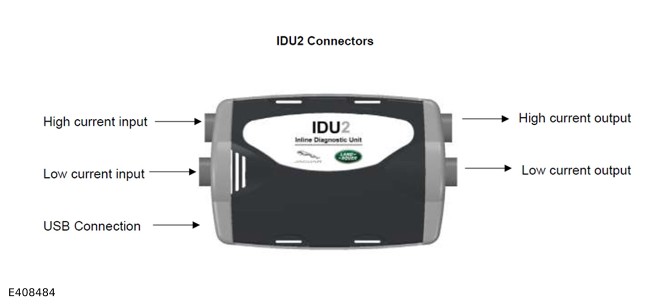
The IDU2 is a 'plug and play' device. It completes a cable test to confirm that the cable is working correctly. Each cable is digitally signed, meaning that the IDU2 can detect if the wrong cable has been plugged in and will advise you of the correct cable to connect.
The NVH Sensor is connected to the JLR approved diagnostic equipment by a Bluetooth® connection. Instructions on how to connect the unit using Bluetooth® are provided when an NVH Sensor application has been launched.
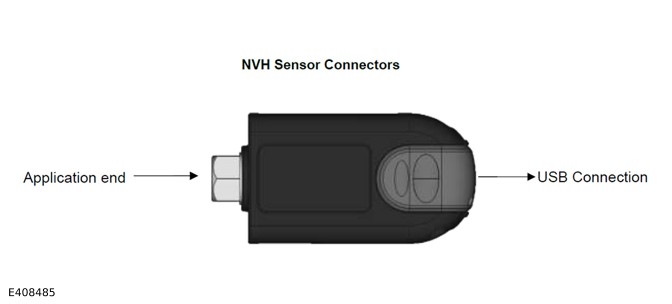
The NVH Sensor requires charging before use.
What will I see when I use an IDU2 or NVH Sensor Application
The application will start with an overview page, explaining what the test consists of and how the test is completed.
You are then presented with clear step-by-step instructions for connecting the IDU2 or NVH Sensor. The screen display will confirm their connection status in the bottom right hand corner.
When the IDU2 or NVH Sensor have been successfully connected as instructed, the application will display pre-test conditions. All instructions on this page must be followed for the application to proceed.
The application will then guide you through the tests, providing instructions for any actions that must be taken in order to complete the test. If any cable changes are required, the application will provide clear step-by-step instructions, including a graphic, for you to follow and complete the action.
When the application has completed, you will be provided with a clear set of results and a pass/fail status for each parameter. Each parameter that has passed will be marked with a green tick, and failed parameters will be marked with a red cross. Based upon the completed test, the application will provide you with a clear direction on any action that needs to be taken to rectify the concern.
What applications are available for the IDU2 and NVH Sensor?
All of the following applications are available on SDD only, with the exception of the engine health check, which is available on both SDD and TOPIx.
IDU2 - Turbocharger/Exhaust Gas Recirculation (EGR) Application
Allows objective diagnosis of turbocharger components. Managed through a combination of inline and component tests, the IDU2 is capable of distinguishing between wiring harness or component faults.
This application is used when there is a suspected electrical fault with either a Turbocharger or EGR valve. This will be indicated by the JLR approved diagnostic equipment.
IDU2 - Engine Health Check
The IDU2 is used to assist you when diagnosing AJ20D4, AJ21D4, AJ20P4, AJ20P6 and AJ20D6 engine concerns.
IDU2is used for:
- Relative compression health check
The JLR approved diagnostic equipment interfaces with the IDU2 to obtain engine cylinder compression.
IDU2 - Non-intrusive Fuel Pump Application
Allows fast, repeatable and objective diagnosis of the fuel tank pump through non-intrusive methods. The IDU2 will analyse the current draw of the Fuel Pump Driver Module (FPDM) through the fuse panels and determine if the performance of the fuel pump is within specification.
This application is used when there is a suspected low pressure fuel delivery issue. This will be indicated by the JLR approved diagnostic equipment.
IDU2 - Non-intrusive Transfer Case Application
Allows Objective Diagnosis of the transfer case functions through non-intrusive methods. The IDU2 will analyse the current draw of the Transfer Case Control Module (TCCM) through the fuse panels and determine if each function of the transfer case is operating within the specification.
This application is used when there is a suspected electrical issue with the transfer case. This will be indicated by the JLR approved diagnostic equipment.
IDU2 - Non-intrusive Latch Application
Allows objective diagnosis of door latch operation through non-intrusive methods. The IDU2 will analyse the current draw from the door latches through the easily accessible fuse panels, this application determines if an interior door trim must be removed for further investigation of the door latch.
This application is used when there is a suspected electrical issue with the side door latches. This will be indicated by the JLR approved diagnostic equipment.
IDU2 - Non-intrusive Window Application
Allows objective diagnosis of front and rear door window regulators operation through non-intrusive methods. The IDU2 will interpret current draw from the door window regulator through the fuse panels and determines if an interior door trim must be removed for further investigation of the system.
This application is used when there is a suspected electrical issue with the side door window regulators. This will be indicated by the JLR approved diagnostic equipment
IDU2 - Remote Function Actuator (RFA)
Allows you to test the remote function actuator motor on the latch from the RFA module's fuse. By connecting the IDU2 to the RFA's fuse and following the instructions from the application, a pass/fail result will be given at the end of the test depending on the current (Amps) performance of the motor.
This application is used when there is a suspected electrical issue with the RFA side door motors. This will be indicated by the JLR approved diagnostic equipment.
IDU2 - Closing Motor
Allows you to test the closing door motor from the fuse of the door module. By connecting the cable IDU04 to the appropriate door module's fuse and following the instructions from the application, you will be given a pass/fail result at the end of the test depending on the current (Amps) performance of the motor.
This application is used when there is a suspected electrical issue with the side door closing motors. This will be indicated by the JLR approved diagnostic equipment.
IDU2 - Power fold Mirror Operation
Allows you to test the power fold motor of a mirror from the fuse of the door module. By connecting the cable IDU04 to the appropriate door module’s fuse and following the instructions from the application, you will be given a pass/fail result at the end of the test depending on the current (Amps) performance of the motor.
This application is used when there is a suspected electrical or mechanical issue with the exterior rear view mirrors power fold actuation. This will be indicated by the JLR approved diagnostic equipment.
IDU2 - Roof Opening Panel
Allows you to interrogate the opening panel blind and the power glass panel if installed from the fuses of the roof opening panels. By connecting the IDU2 to the appropriate fuse and following the instructions from the application, a pass/fail result will be given at the end of the test depending on the current (Amps) performance of the motor and the different switch status.
This application is used when there is a suspected electrical issue with the roof opening panel. This will be indicated by the JLR approved diagnostic equipment.
NVH Sensor - Turbocharger Application
Allows fast, repeatable and objective diagnosis of turbocharger mechanical faults. This removes the inaccuracy of human interpretation of noise levels and provides a set limit above which components are determined to be faulty.
This application is used when there is a suspected noise concern with the Turbocharger. This will be indicated by the JLR approved diagnostic equipment.
NVH Sensor - Accessory Drive Application
Allows fast, repeatable and objective diagnosis of accessory drive pulley balance. Out of balance pulleys are flagged for further investigation.
This application is used when there is a suspected Front End Accessory Drive (FEAD) concern causing the engine to vibrate. This will be indicated by the JLR approved diagnostic equipment.
NVH Sensor - Transfer Case Application
Allows fast, repeatable and objective diagnosis of the transfer case noise through the measurement of vibrations on the outer casing. This vibration can be characterised and objectively interpreted.
This application is used when there is a suspected noise concern with the transfer case when the vehicle is in motion. This will be indicated by the JLR approved diagnostic equipment.
NVH Sensor - Differential Unit Application
Allows fast, repeatable and objective diagnosis of the differential unit noise through the measurement of vibrations on its ouer casing. This vibration can be characterised and objectively interpreted.
This application is used when there is a suspected noise concern with either the front or rear differential when the vehicle is in motion. This will be indicated by the JLR approved diagnostic equipment.
NVH Sensor - Wheel Imbalance Application
Allows for repeatable objective tests which check for wheel imbalances present in the front and rear wheels of the vehicle. By attaching the NVH sensor to the steering wheel using the steering wheel strap, the NVH sensor and software is capable of interpreting the vibrations on the steering wheel to identify the location of wheel imbalances that are present.
This application is used when there is a suspected wheel imbalance concern or tire flat spot issue. This will be indicated by the JLR approved diagnostic equipment.
Windshield Wiper Park Switch Diagnostic
Allows the technician to interrogate the speed of the wiper park position switch on the wiper motor against the wipers and washers control switch. You will be instructed to close the tailgate, have the engine running and activate the front wipers and washers control switch to the maximum setting. The software will interrogate the status of the switch against the feedback of the wiper park position switch on the motor. A pass/fail result will be given at the end of the test depending on the speed of the motor.
This application is used when there is a suspected electrical or mechanical issue with the windshield wiper park switch. This will be indicated by the JLR approved diagnostic equipment.
Rear Wiper Park Switch Diagnostic
Allows you to interrogate the speed of the wiper park position switch on the wiper motor against the wipers and washers control switch. You will be instructed to close the hood, have the engine running and actuate the rear wiper and washer control switch to the maximum setting. The software will interrogate the status of the switch against the feedback of the wiper park position switch on the motor. A pass/fail result will be given at the end of the test depending on the speed of the motor.
This application is used when there is a suspected electrical or mechanical issue with the rear wiper park switch. This will be indicated by the JLR approved diagnostic equipment.
IDU2 and NVH Sensor Training
Training for the IDU2 and NVH Sensor is available in Personal Study Module PDAX00777 - SDD Features and Functions Lesson 5, on Excellence for all technicians. This Personal Study Module introduces the IDU2 and NVH Sensor, focusing on how the tools can be used in conjunction with SDD to successfully diagnose faults. Detailed descriptions about the IDU2 and NVH Sensor applications are available within this Personal Study Module.